

The Exam That Gets Better With Every Driver
In this article
- Am I ready, and what do I do this week?
- The next question should tell us the most about you
- Your hours go where the marks are
- Every turn is a skill the exam tests
- An honest picture, even when it stings a little
- A few road signs along the way
- Your record is yours
- Every driver redraws the map
- The first rating is a starting point
- When the traffic outranks the sign
- Finding the closed roads
- New roads open inside ordinary practice
- Why the guide and the map need each other
- The only measure that matters
- For teams and managers
- Learn Smarter
- Frequently asked questions
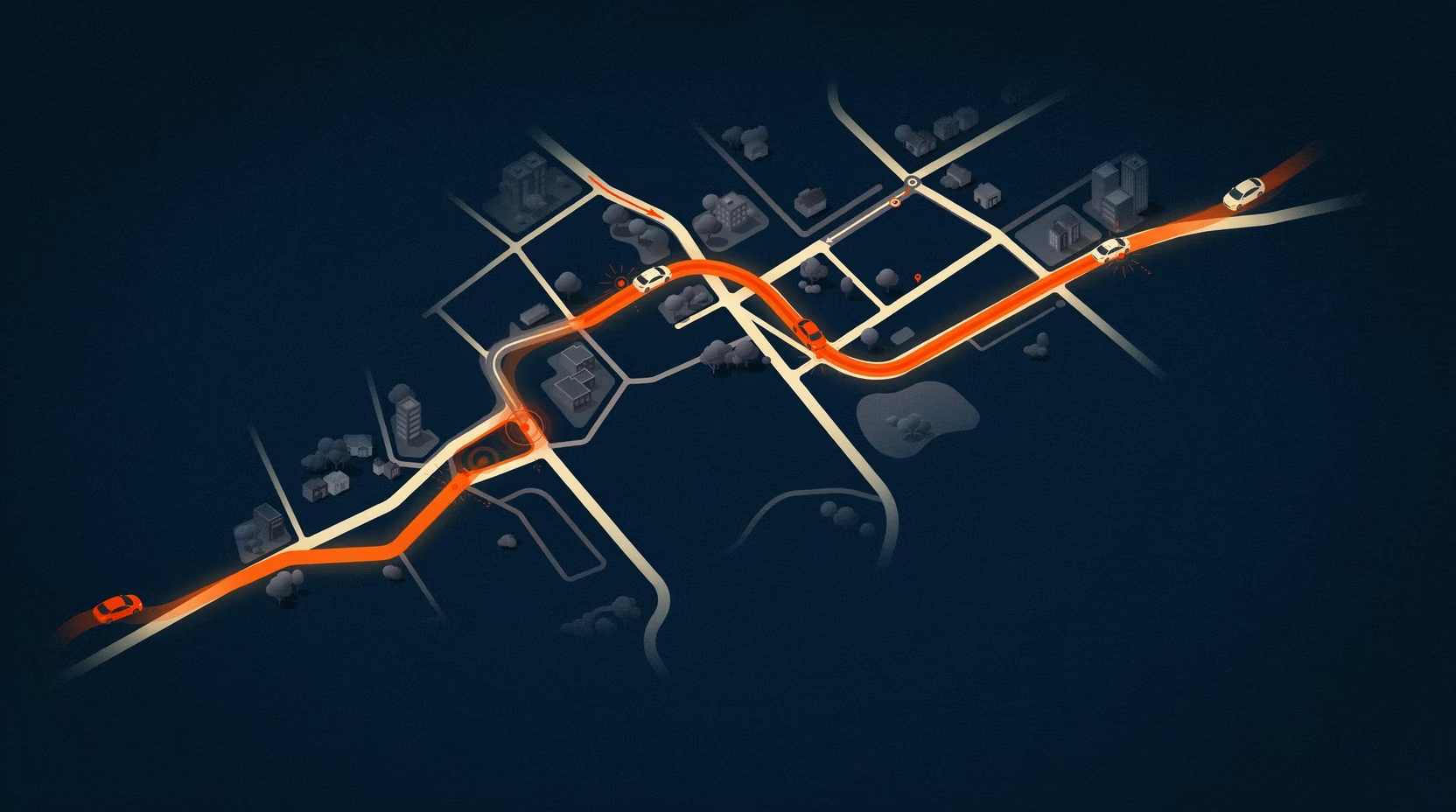
Think about how you drive to a place you have never been. You do not unfold a paper map drawn years ago by one person. You open Waze. It knows where you are, picks the best route for you, and changes it the moment the road changes.
Here is the part that matters. Waze is not smart because someone wrote better directions. It is smart because so many drivers are on the road at the same time. A crash, a closed lane, a slow stretch: the first drivers through report it by simply driving it, and every driver after them gets a better trip.
That is how Compleat Exams works, and it is the idea behind everything we build. There are two jobs, and they are really one: get you to exam day by the best route for you, and keep the map true while you drive.
Am I ready, and what do I do this week?
When you are preparing for an exam, you are not looking for more questions. You are looking for one answer: am I ready, and what should I do this week?
Waze does not hand you a longer list of roads. It picks your next turn. Here is what that means for you.
The next question should tell us the most about you
That is usually a question you have about an even chance of getting right, in the areas your exam weights most heavily. Too easy and we learn nothing. Too hard and we learn nothing. Right in the middle, we learn what you actually know.
Your hours go where the marks are
The main highways decide the trip. Your exam does not weight every topic equally, so your study time should not either. We point you at the areas that carry the most marks, not the areas where the reading list happens to be longest.
Every turn is a skill the exam tests
Our questions are built around the competencies your exam asks for, the things a competent professional must be able to do, not a pile of facts to memorise. Each question is tied to one of those competencies. So when we tell you where you stand, we tell you in the terms the exam uses: this skill is solid, that one needs another pass. That is what turns a score into a plan for this week. (Our [competency and adaptive learning article](/blog/competency-and-adaptive-learning) goes deeper.)
An honest picture, even when it stings a little
A pass built on lucky answers is a comfortable score that can collapse under the real examination. So we ask whether an answer was a guess. If you guessed and happened to be right, that answer goes on your "work on" list, not your "known" list. You reached that exit by a lucky turn, so we mark the stretch to drive again, before exam day instead of on it.
A few road signs along the way
Every industry has its own language, and talking the talk matters when you are new to an industry, or when English is not your first language. So the help comes to you where you need it. Industry terms are explained right inside questions and answers. Your answer guide is bookmarked and leads you to the relevant text in your study guide, and you can turn it into flashcards in a tap.
Your record is yours
Your progress belongs to you. Coming back later means resuming, not starting over.
Every driver redraws the map
Here is the second job, and it is the part most practice tools never do. It is the Waze part.
Every test you take is also evidence about the questions.
The first rating is a starting point
A writer's label of easy, medium or difficult is an honest first guess. It is not a measurement. We built the system to replace it with one, using what real candidates actually did.
When the traffic outranks the sign
Once a question has been answered enough times by enough different people, those answers outrank the label. How often it is answered correctly becomes its real difficulty. With more answers still, we learn how sharply it separates stronger candidates from weaker ones. Until a question has earned that, the label stands, and we say so rather than pretending. That is not a limitation. It is the difference between a measured question and a confident guess.
Finding the closed roads
The same evidence finds the questions that are badly written: the one almost everyone gets right, the one almost nobody gets, the one with two defensible answers, the one whose explanation does not match its key. Those get fixed or retired, and the next candidate never meets them.
New roads open inside ordinary practice
This is how the questions stay true as an examination changes. A new question arrives already being tested inside normal practice, not announced as an experiment, because announcing it would change how people answer.
Why the guide and the map need each other
A route planner with a map nobody has checked is only guessing. "Adaptive" turns into sorting questions by opinion, and a readiness figure becomes a number with nothing behind it. You would be told something confident that the data does not support.
A true map with no drivers is just as useless. Waze without drivers is only a paper map. Measured questions need someone to drive them.
So the loop is the whole point. You answer. Your answer measures the question. The better question reaches the next candidate, and their answer measures it further. The system improves because people use it, not because someone has to rewrite it by hand.
The only measure that matters
We do not judge this technology by how many questions it holds. We judge it by one test: is the question a candidate sees today better than the one the last candidate saw?
For teams and managers
If your team is measured on passes, the same loop works for you. People get a readiness picture they can trust, their hours go to the areas that carry the marks, and the practice they use improves with every person who uses it. We do not promise a pass. We promise a more honest answer to the question every candidate and every manager is asking: are they ready?
Learn Smarter
A driver with a live map does not drive further. They drive smarter. And every candidate who practises with us makes the map truer for the next one, so everyone learns smarter together.
The right question for you today. Better questions for everyone tomorrow.
Learn Smarter.
Related reading: [The Compleat Exams Method: A Simple Guide](/method) · [Competency and adaptive learning](/blog/competency-and-adaptive-learning)
Frequently asked questions
What is adaptive exam practice?
Adaptive exam practice chooses each next question based on how you have answered so far, so your study time goes to the questions and topics that move your result most.
How does Compleat Exams choose my next question?
It looks for a question you have about an even chance of getting right, in the areas your exam weights most heavily. Those questions tell us the most about what you know.
Why does it ask whether I guessed?
Because a lucky right answer is not knowledge. If you guessed and were right, that topic goes on your "work on" list, so a pass built on luck shows up before exam day.
How do you know how hard a question really is?
At first we use the writer's easy, medium or difficult label. Once a question has been answered enough times by enough different people, the real results replace the label. Until then, the label stands and we say so.
What happens to badly written questions?
The same evidence flags them: questions almost everyone gets right, almost no one gets right, with two defensible answers, or with an explanation that does not match the key. They are fixed or retired before the next candidate sees them.
Do I lose my progress if I leave and come back?
No. Your record belongs to you, and coming back means resuming where you left off.
Is a readiness figure a promise that I will pass?
No. It shows where you stand and what to work on this week. It is guidance backed by your own results, not a guarantee.
See what to study next
Take an assessment to see how Compleat Exams explains answers and helps you identify topics to review.
Preparing staff for an exam? Discuss preparation for your team.